

Office No.104, Sahakar Niwas, Plot No.160/161, Rd no.2, Jawahar Nagar, Goregaon(West), Mumbai-400062
Office No.104, Sahakar Niwas, Plot No.160/161, Rd no.2, Jawahar Nagar, Goregaon(West), Mumbai-400062
Mumbai is home to corporate offices, financial institutions, IT companies, manufacturing facilities, hospitals, warehouses, and data centers that depend on reliable electrical power. Even a brief interruption can disrupt business applications, interrupt transactions, affect production schedules, and put valuable equipment at risk.
For businesses operating in Mumbai and Navi Mumbai, choosing the right uninterruptible power supply (UPS) is an important investment in operational continuity. A suitable UPS helps protect connected equipment from power interruptions and, depending on the model, can also provide protection against voltage fluctuations and other electrical disturbances.
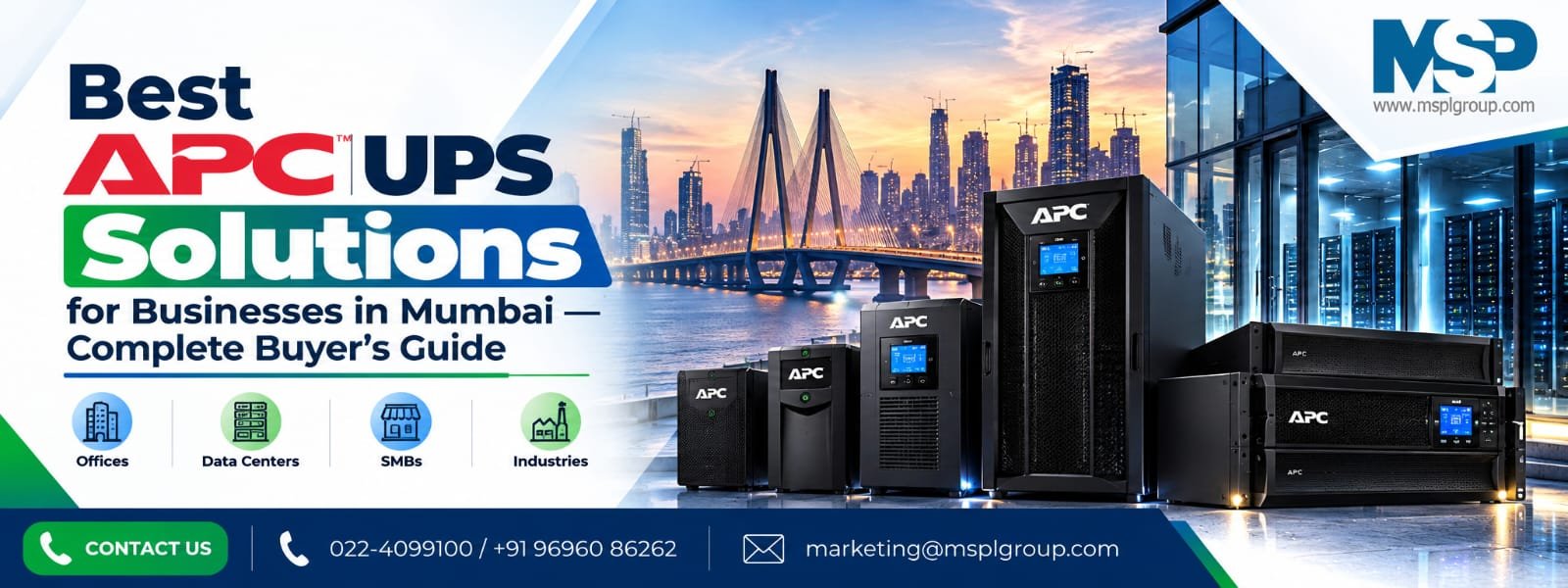
APC by Schneider Electric offers UPS product families for different requirements, ranging from small office equipment and network devices to enterprise IT infrastructure and three-phase critical-power applications. However, the best APC UPS for a business depends on its connected load, required backup duration, electrical environment, expansion plans, and budget.
MSPL Group, also known as Mahavir Sys-Power Pvt. Ltd., has operated in the power backup industry since 1994 and identifies itself as a premium APC by Schneider Electric partner on its website. The company provides UPS-related solutions and support for businesses across Mumbai and other locations.This complete buyer’s guide explains how to choose APC UPS systems for Mumbai businesses, compare the main product families, calculate capacity, evaluate battery backup, understand total ownership costs, and plan professional installation and maintenance.
An APC UPS is a power protection system designed to provide temporary battery-backed power when the incoming electricity supply fails or falls outside the unit's supported operating range.Depending on the model, a UPS can also help protect connected equipment against voltage disturbances and provide a controlled transition to backup power.
Business applications include:
A UPS is not a substitute for a generator or an appropriately designed long-duration backup system. Its runtime depends on the connected load, battery configuration, battery condition, and operating conditions.
For Mumbai businesses, the goal should be to select a UPS that protects critical equipment while allowing sufficient time for power restoration, transfer to an alternative supply, or safe shutdown.
APC offers different UPS families for different load sizes and operating requirements. Selecting the correct product category is more important than choosing a model simply because it has a high VA rating.
| APC UPS family | Typical application | Main selection consideration |
| Back-UPS | Home offices and selected small-office equipment | Load capacity and basic backup needs |
| Easy UPS | Small businesses and selected commercial applications | Model-specific capacity and power protection |
| Smart-UPS | Business IT, servers, networking, and critical electronics | Runtime, monitoring, and power quality |
| Smart-UPS On-Line | Sensitive or critical loads requiring online double-conversion technology | Power conditioning and supported load |
| Easy UPS 3S | Three-phase commercial and industrial applications | Site electrical configuration and capacity |
| Larger three-phase UPS solutions | Enterprise infrastructure and critical facilities | Redundancy, scalability, serviceability, and design |
The suitability of each family depends on the exact model, voltage configuration, power rating, and installation requirements. Not every model is available in every market or configuration.
For specifications, consult the official website and request a model-specific recommendation from your supplier.
APC Smart-UPS systems are designed for business-critical IT and networking applications, with features varying by model.
They may be suitable for offices that operate servers, network storage, routers, switches, communication systems, and other equipment that cannot tolerate an uncontrolled shutdown.
When evaluating an APC Smart-UPS, check:
For example, a Mumbai-based IT company running virtual servers may require more than enough capacity to keep its servers powered. It may also need monitoring alerts, predictable runtime, and integration with shutdown software.
Businesses should select the exact Smart-UPS model only after assessing their connected equipment and runtime requirements.
Need help selecting APC Smart-UPS for your office? Contact MSPL Group for guidance based on your load, infrastructure, and backup requirements.
Businesses with three-phase electrical infrastructure may need a UPS designed for larger loads than those supported by typical desktop or small-office systems.
The APC Easy UPS 3S family is intended for applicable three-phase power protection requirements. Depending on the configuration, it may be considered for commercial facilities, industrial applications, and selected IT environments.
Potential applications include:
Before purchasing, verify the exact unit's input and output configuration, rated power, battery arrangement, installation requirements, bypass provisions, and service access.
Three-phase UPS installation involves electrical design considerations that should be assessed by qualified professionals. Businesses should not select a three-phase system based only on total connected VA.
For facilities with higher capacity requirements, a site survey can establish whether an Easy UPS 3S configuration or another enterprise UPS architecture is more appropriate.
Correct UPS sizing is one of the most important steps in the buying process.
A UPS must support the actual electrical load in watts and VA while accounting for power factor, load behaviour, future expansion, and the manufacturer's operating limits.
Start by listing all the equipment that must remain powered during an outage. Record each device's rated or measured power consumption, then identify equipment that must operate simultaneously.
A basic starting point is:
Total load (W) = Sum of the operating power of all connected devices
The selected UPS must have a watt rating sufficient for that load. Its VA rating must also accommodate the apparent power requirements of the equipment.
For example, if critical devices consume 1,200 W in total, a UPS rated at 1,200 W would leave no additional capacity for future expansion or unexpected load changes. The actual selection should account for the manufacturer's recommendations and the nature of the connected equipment.
For motor-driven loads, compressors, and other equipment with high starting currents, a more detailed engineering assessment is necessary.
Avoid oversizing without justification, but do not operate the UPS so close to its limit that normal load variation creates a reliability problem.
The choice between online and line-interactive UPS technology depends on the sensitivity of the connected equipment and the required power protection.
| Feature | Line-interactive UPS | Online double-conversion UPS |
| Typical applications | Small offices and selected IT loads | Critical IT and sensitive equipment |
| Voltage regulation | Usually through automatic voltage regulation | Continuous AC-to-DC-to-AC conversion |
| Transfer during battery operation | Model-dependent transfer time | Normally no transfer interruption between inverter supply and battery operation |
| Electrical isolation from input disturbances | Limited and model-dependent | Stronger control of output power characteristics |
| Efficiency | Depends on model and operating mode | Depends on model and operating mode |
| Typical cost | Often lower for comparable smaller loads | Often higher for comparable applications |
An online UPS may be preferable for systems that require continuous inverter output and tightly controlled power characteristics. A line-interactive UPS may be adequate for less demanding applications.
The decision should be based on the equipment manufacturer's power requirements, the quality of the incoming supply, and the consequences of an interruption.
Corporate offices commonly depend on computers, network equipment, video-conferencing systems, communication devices, and shared IT infrastructure.
A practical office UPS plan separates essential loads from equipment that can be switched off during a power interruption.
For example, the office may prioritise:
Printers, pantry appliances, heaters, and other noncritical loads should not automatically be connected to the same UPS.
For larger offices, distributed smaller UPS units may be appropriate for selected workstations, while a dedicated system may be more suitable for a server room.
A professional assessment helps determine the most practical architecture for the office layout and equipment.
Data centers and server rooms require careful planning because power interruption can affect multiple applications simultaneously.
The UPS must be sized for current server loads, networking, storage, and other supported equipment. The design should also consider future rack density, redundancy, maintenance access, and battery runtime.
Important considerations include:
A redundant design can improve resilience, but it must be engineered correctly. Two UPS units do not automatically provide redundancy if they share a single point of failure elsewhere in the power chain.
For data centers in Mumbai, a UPS assessment should also consider room temperature, ventilation, dust exposure, and the physical space available for batteries and distribution equipment.
Manufacturing plants often require power protection for programmable logic controllers (PLCs), industrial computers, control panels, instrumentation, communication equipment, and other critical control systems.
The requirements differ from those of a typical office because industrial environments may include electrical noise, vibration, elevated temperatures, and demanding operating schedules.
An industrial UPS assessment should consider:
Not every production motor or high-power machine should be connected directly to a standard UPS. Some loads require dedicated engineering, while others may be better supported through separate control-power systems.
MSPL Group can be approached for a site-specific discussion about UPS requirements for manufacturing plants and industrial control applications.
Backup duration is determined by the UPS design, battery capacity, load level, battery condition, and environmental conditions.
A UPS that supports a load successfully for a short interruption may not provide sufficient runtime for a prolonged outage.
Businesses should establish a clear target, such as:
Runtime should be verified against the manufacturer's runtime charts or approved sizing tools. It should not be estimated using battery capacity alone.
Battery performance also changes with age, temperature, discharge rate, and maintenance history. A runtime test or appropriate battery assessment may be needed for existing installations.
If the business requires extended backup, compare the cost and practicality of additional supported battery capacity with alternative power arrangements.
There is no single APC UPS price that applies to every business. The final cost depends on the model, capacity, battery configuration, installation requirements, and service package.
Major cost factors include:
A smaller office UPS and a three-phase enterprise system serve very different purposes, so their prices should not be compared without considering the application.
When requesting quotations, ask for the exact model number, rated watts and VA, battery configuration, warranty, installation scope, and applicable taxes.
Request a customised APC UPS quotation from MSPL Group after sharing your equipment load, required runtime, and installation location.
Battery selection has a major influence on UPS runtime, maintenance, and long-term ownership cost.
Many UPS systems use valve-regulated lead-acid (VRLA) batteries, while selected newer systems support lithium-ion battery technology.
| Consideration | VRLA batteries | Lithium-ion batteries |
| Initial purchase cost | Often lower | Often higher |
| Weight and space | Generally heavier and bulkier for comparable usable energy | Often lighter and more compact |
| Service life | Depends on battery type and operating conditions | Depends on chemistry, design, and operating conditions |
| Monitoring | Model and installation-dependent | Often includes more detailed battery management |
| Compatibility | Must match the UPS specification | Must be explicitly supported by the UPS design |
Do not assume that lithium-ion batteries can be substituted directly for lead-acid batteries. The battery chemistry, voltage, charging profile, protection system, communications, and manufacturer approvals must all be compatible.
For existing APC systems, identify the UPS model and approved replacement battery before purchasing.
The purchase price is only one component of the total cost of owning a UPS.
A system that is inefficient at the facility's normal operating load can consume more electricity over its lifetime. Battery replacements, maintenance, cooling, and downtime also contribute to total cost.
Total cost of ownership should consider:
Compare efficiency figures under similar operating conditions. A published maximum efficiency value may not represent performance at the load level where the business normally operates.
Correct sizing is equally important. An unnecessarily oversized UPS may increase upfront cost and can affect efficiency, depending on the model and operating mode.
The financial value of a UPS includes both direct operating costs and the business losses it may help prevent.
Direct savings may result from better efficiency, suitable sizing, and improved maintenance planning. Avoided downtime may be even more important for businesses where interruptions affect revenue or production.
Consider this illustrative example:
A business estimates that a power-related interruption costs ₹25,000 in lost productivity and recovery expenses. If a suitable UPS arrangement helps avoid four comparable incidents annually, the estimated avoided cost would be ₹1,00,000 per year.
If the UPS installation costs ₹3,00,000, the simple payback based solely on those assumed avoided costs would be three years.
| ROI factor | Illustrative value |
| UPS installation investment | ₹3,00,000 |
| Assumed costly incidents avoided annually | 4 |
| Assumed cost per incident | ₹25,000 |
| Estimated annual avoided cost | ₹1,00,000 |
| Simple payback based on avoided costs | 3 years |
This is an example, not a guaranteed result. Actual savings depend on interruption frequency, business impact, system effectiveness, and operating costs. The calculation excludes financing, battery replacement, electricity losses, and other lifecycle expenses.
A detailed business case should compare the expected costs of the UPS system with the financial and operational consequences of not protecting the critical load.
Professional installation helps ensure that the UPS is correctly sized, connected, tested, and commissioned.
Before installation, verify the electrical supply, available space, ventilation, floor loading where relevant, earthing, cable sizing, and required protective devices.
Three-phase installations and external battery arrangements require particular attention to electrical safety and manufacturer instructions.
A typical installation plan includes:
The installation should also account for service access and future replacement needs.
Businesses should request a written scope of work that clearly identifies what the supplier will provide and what must be prepared by the customer.
A UPS is a critical electrical asset, and maintenance should be planned rather than left until a failure occurs.
An annual maintenance contract (AMC) may include scheduled inspections, battery assessments, operational checks, and support according to the agreed service scope.
Preventive maintenance can help identify deteriorating batteries, abnormal temperatures, blocked ventilation, alarms, and other developing issues.
A suitable maintenance plan should specify:
Maintenance requirements vary by UPS model, battery technology, operating environment, and criticality.
Businesses in Mumbai and Navi Mumbai can contact MSPL Group to discuss UPS maintenance and battery replacement options for supported installations.
Choosing a supplier involves more than comparing the lowest quotation.
A reliable supplier should be able to explain the differences between UPS models, assess the intended load, provide a clear installation proposal, and identify the appropriate maintenance arrangements.
Before purchasing, check:
Businesses should independently verify current partner status, warranty conditions, and the precise scope of support before placing an order.
MSPL Group operates from Goregaon West, Mumbai, and provides UPS-related sales and support services. Contact the team to discuss requirements for office, server-room, and industrial power protection.
Contact MSPL Group
Selecting the right UPS requires technical assessment, appropriate product selection, and a plan for long-term support.
MSPL Group has been operating in the power backup industry since 1994 and identifies itself as a premium APC by Schneider Electric partner. Its website describes UPS solutions for business customers and related services, including installation and maintenance support.
Businesses can approach MSPL Group to discuss:
The appropriate recommendation will depend on the business's actual requirements and the available product configuration.
For a more accurate quotation, provide your location, equipment list, total load, required backup duration, and whether the installation is single-phase or three-phase.
Plan your business power backup with MSPL Group. Contact the team to discuss a suitable APC UPS configuration for your Mumbai facility.
1. Which APC UPS is best for businesses in Mumbai?
The best option depends on the connected load and required level of power protection. Back-UPS may suit selected small-office applications, Smart-UPS can support business IT infrastructure, and Easy UPS 3S may suit applicable three-phase requirements. Verify the exact model specifications before buying.
2. What is the difference between APC Smart-UPS and APC Easy UPS?
These are different APC product families intended for different applications and requirements. Smart-UPS models commonly serve business IT and networking applications, while Easy UPS models cover several entry-level, commercial, and three-phase use cases. Compare the exact models rather than assuming every product in one family has identical features.
3. How do I calculate the correct APC UPS capacity?
List all equipment that must remain powered, determine its actual operating load in watts, and verify the corresponding VA requirement. Allow for load changes and future expansion, and consider equipment with high starting currents. Use manufacturer specifications or a professional load assessment to confirm the final size.
4. How long can an APC UPS provide battery backup?
Runtime depends on the UPS model, connected load, battery configuration, battery condition, and environmental factors. Use the manufacturer's runtime information for the selected configuration and verify the backup duration required by your business.
5. What is the APC UPS price in Mumbai?
Pricing varies by capacity, model, battery configuration, installation scope, and warranty. Request a quotation for the exact UPS model and include installation, battery requirements, and ongoing maintenance when comparing offers.
6. Is an online APC UPS better for servers?
An online double-conversion UPS can be appropriate for servers and other sensitive equipment requiring continuous inverter output and tightly controlled power characteristics. The final choice depends on equipment requirements, load, runtime, and budget.
7. Can an APC UPS protect industrial equipment?
Selected APC UPS models can protect compatible industrial control systems and critical equipment. However, high-power machinery and motor loads require a detailed assessment of starting current, electrical configuration, and operating conditions.
8. When should APC UPS batteries be replaced?
Battery replacement depends on the battery type, operating temperature, discharge history, condition, and manufacturer recommendations. Routine inspections and appropriate battery tests help identify when replacement is necessary.
9. Does MSPL Group provide APC UPS installation and maintenance in Mumbai?
MSPL Group's website describes UPS sales, installation, and related support services. Contact the company to confirm current availability, supported models, service coverage, and the terms applicable to your installation.
10. What information should I provide when requesting an APC UPS quotation?
Share your business location, connected equipment list, total load, required runtime, electrical phase, installation environment, and plans for expansion. This information helps the supplier recommend a suitable UPS configuration and prepare a more accurate quotation.
The best APC UPS solution for a business in Mumbai is one that matches its actual electrical load, required backup duration, operating environment, and future growth plans.
Small offices may need compact power protection for computers and networking equipment, while server rooms and industrial facilities may require online UPS technology, external batteries, three-phase systems, or a carefully engineered redundant architecture.
Before purchasing, compare the exact product specifications, total ownership cost, warranty, installation requirements, and maintenance arrangements. Correct sizing and professional commissioning can help protect critical equipment and reduce the risks associated with unexpected power interruptions.
MSPL Group provides a starting point for businesses seeking APC UPS solutions in Mumbai. Contact the team to discuss your requirements and identify a suitable power protection system for your workplace.
Get expert guidance for your APC UPS purchase today.
Phone: +91 08048128715
Email: pranav.shah@msplgroup.com
Website: https://www.msplgroup.com

Your email address will not be published.


Comments