

Office No.104, Sahakar Niwas, Plot No.160/161, Rd no.2, Jawahar Nagar, Goregaon(West), Mumbai-400062
Office No.104, Sahakar Niwas, Plot No.160/161, Rd no.2, Jawahar Nagar, Goregaon(West), Mumbai-400062
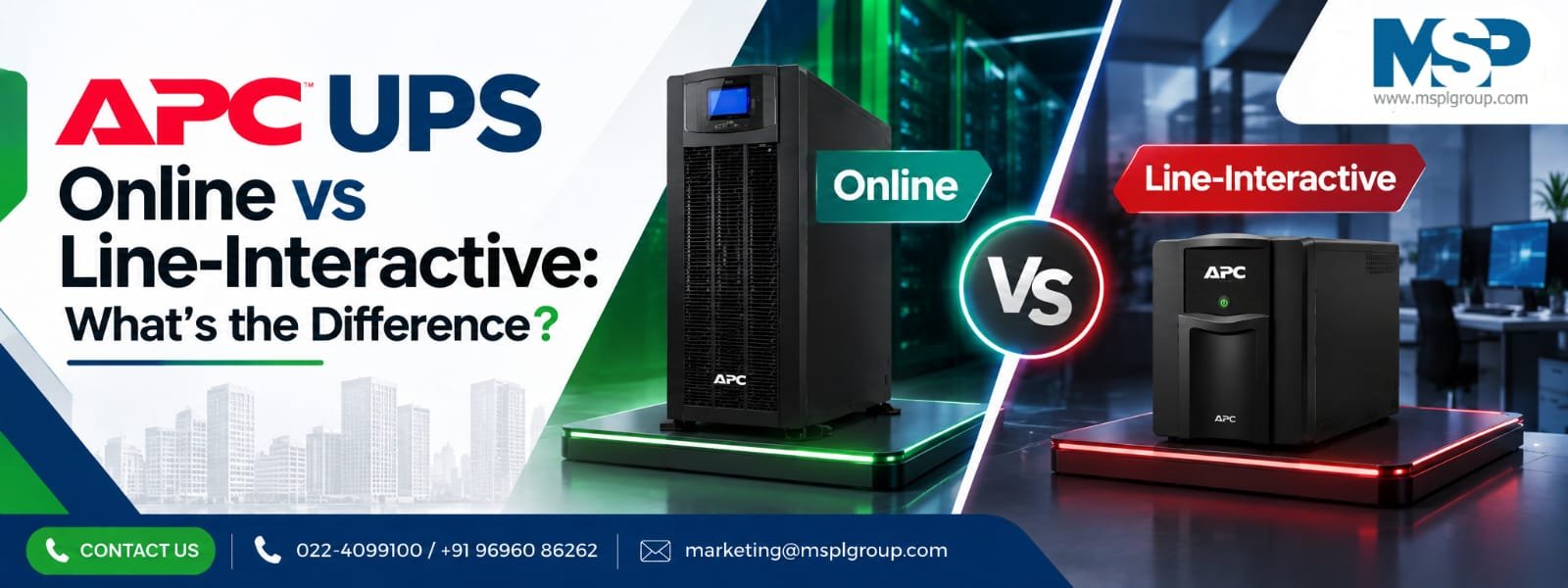
Choosing the right uninterruptible power supply (UPS) is not simply about selecting the highest VA or kVA rating. The UPS topology—how the UPS manages incoming electricity and protects connected equipment—also matters.Two commonly considered options are Online UPS and Line-Interactive UPS. Both can provide battery backup and protection against power interruptions, but they handle voltage fluctuations and power disturbances differently.
APC, a Msplgroup brand, offers UPS solutions across different applications. Its Smart-UPS portfolio includes both Line-Interactive and Online solutions, while APC Easy UPS also includes Line-Interactive models and Online configurations. Msplgroup describes its Smart-UPS On-Line range as using double-conversion online technology, while its Line-Interactive products use a different architecture designed for applications where this level of continuous power conditioning may not be necessary.
So, APC UPS Online vs Line-Interactive—which should you choose?
The answer depends on your equipment, power-quality conditions, business criticality, runtime requirements, budget and future expansion plans.This guide explains the technical differences in simple terms and shows where each type can make sense.
An APC UPS is a power protection system designed to provide backup power and help protect connected equipment from power interruptions and electrical disturbances.Depending on the model and topology, an APC UPS can support equipment such as:
APC Smart-UPS solutions are positioned for applications including servers, networks and other IT equipment, while APC Easy UPS products cover a range of home, office and business requirements.The important point is that not every APC UPS works in the same way. The topology determines how power is delivered to the connected load.
An Online UPS, commonly called a double-conversion UPS, continuously processes incoming AC power.
The basic process is:
AC input → DC conversion → energy storage/DC bus → AC output → connected equipment
This means the connected equipment receives power generated by the UPS rather than simply receiving utility power until an outage occurs.Msplgroup describes APC Smart-UPS On-Line as providing high-density, double-conversion online power protection with scalable runtime.
Why does double conversion matter?
Incoming electricity can experience:
An Online UPS is designed to provide tightly regulated output while continuously conditioning the incoming power.
This makes the topology particularly relevant when power quality is as important as backup power.
A Line-Interactive UPS normally supplies utility power to the connected equipment while using internal power-management circuitry to regulate certain voltage variations.One of its important features is Automatic Voltage Regulation (AVR).
Instead of immediately using the battery whenever there is a moderate voltage fluctuation, AVR can adjust the voltage while the UPS remains connected to utility power.This can help reduce unnecessary battery cycling.
APC's product information identifies several Smart-UPS families as Line-Interactive, while APC Easy UPS SMV is specifically described as a Line-Interactive UPS with sine-wave output designed to handle a wide input-voltage range.
For many:
a Line-Interactive UPS can provide practical power protection without the architecture of a double-conversion system.
| Feature | APC Online UPS | APC Line-Interactive UPS |
| UPS topology | Double conversion | Line interactive |
| Power conditioning | Continuous | Mainly voltage regulation |
| Transfer during outage | No conventional transfer gap in online operation | Transfers to battery when utility power is outside acceptable limits |
| Voltage regulation | Tight | AVR-based |
| Power-quality protection | Very high | Good for many applications |
| Battery usage | Continuous power-processing architecture | Battery generally used during outages/conditions requiring it |
| Typical applications | Servers, critical IT, data centers, sensitive equipment | Offices, PCs, networking and less-critical equipment |
| Initial cost | Generally higher | Generally lower |
| Efficiency | Model-dependent | Often efficient for suitable loads |
| Complexity | Higher | Lower |
| Best suited to | Critical loads | General business/office loads |
The exact specifications—including efficiency, transfer characteristics, output waveform, runtime and allowable input range—vary by model, so the manufacturer's datasheet should always be checked before purchase.
The biggest difference is how the UPS handles incoming electricity.A Line-Interactive UPS can regulate moderate voltage variations using AVR and typically switches to battery operation when input power moves outside its acceptable range.
An Online UPS continuously performs double conversion, meaning incoming AC is converted to DC and then converted back into regulated AC for the load. Msplgroup 's technical documentation explains this double-conversion architecture and notes that all power supplied to the load passes through the conversion process during normal AC operation.
In simple terms:
Line-Interactive:
“Utility power is usable, so I regulate it and keep the battery ready.”
Online:
“I continuously create regulated output power for the equipment.”
That distinction becomes important for sensitive and business-critical loads.
Transfer time is another important consideration.
With a Line-Interactive UPS, the load normally operates from utility power. If the input becomes unacceptable, the UPS switches to its inverter/battery path.
With an Online UPS, the load is already being supplied through the UPS's power-conversion architecture. Therefore, the traditional utility-to-battery transfer event is not the same issue.For highly sensitive equipment, this architecture can be particularly useful.
APC Smart-UPS On-Line products are designed around double-conversion online protection, and Msplgroup documentation describes Online UPS systems as continuously conditioning power.
If your biggest concern is power quality, Online UPS technology is generally the more comprehensive architecture.
A business may experience:
An Online UPS can continuously regenerate the output and provide tighter power conditioning.
Line-Interactive UPS systems, however, can be entirely appropriate when the electrical environment is reasonably stable and the primary requirement is backup power plus voltage regulation.
Practical rule
If your equipment is power-sensitive and business-critical, evaluate Online UPS.
If your equipment needs reliable backup and voltage regulation at a lower system complexity, Line-Interactive UPS may be appropriate.
Servers and data-center equipment can be highly sensitive to power interruptions and disturbances.
A server outage can result in:
For these environments, an Online UPS can provide continuous power conditioning.
APC Smart-UPS On-Line is specifically positioned for applications requiring high-density, double-conversion power protection and scalable runtime.
Example
Consider a small server room running:
If the equipment is operationally critical, an Online UPS can be evaluated based on the required capacity, redundancy, runtime, bypass architecture and monitoring requirements.
An office with:
may not require the same power architecture as a data center.
A Line-Interactive UPS can provide battery backup and AVR-based voltage regulation for suitable equipment.
For example, APC Easy UPS Line-Interactive products are designed for applications where protection from power disturbances and backup are needed. Msplgroup describes the Easy UPS SMV series as Line-Interactive with sine-wave output and a wide input-voltage range.
The right model should still be selected according to the actual load and equipment requirements.
Manufacturing environments can have more complicated electrical conditions.
Loads may include:
A UPS selection should consider not only backup duration but also:
For critical industrial controls, an Online UPS may be considered when continuous power conditioning is important.
However, a Line-Interactive UPS can be suitable for selected non-critical control or office loads within an industrial facility.
UPS efficiency is an important part of the total cost of ownership.An Online UPS continuously processes power through its conversion stages. A Line-Interactive UPS can avoid continuous double conversion in normal operating conditions, depending on its operating mode and design.This does not mean that one topology should automatically be selected based only on efficiency.
The correct evaluation should include:
Energy consumption + equipment protection + downtime risk + maintenance + battery replacement + scalability + purchase cost
Some APC Online models also provide energy-saving operating modes. For example, an APC Easy UPS On-Line 2000VA model listed by Msplgroup includes an ECO mode and double-conversion architecture.
A Line-Interactive UPS generally has a lower entry cost for comparable smaller-capacity applications, while an Online UPS can require a higher initial investment because of its more comprehensive power-conversion architecture.But purchase price alone does not determine ROI.
Consider this example
Suppose a business operates a critical application that generates ₹1 lakh of productive or transaction value per hour.
If a power problem causes one hour of avoidable downtime, the business impact could be substantially greater than the initial difference between two UPS options.
This is why a UPS ROI calculation should consider:
Simple ROI framework
UPS ROI = Avoided downtime cost + avoided equipment loss + productivity protection − total UPS lifecycle cost
Actual financial results vary by business and should be calculated using the company's own downtime and operating data.
Neither Online nor Line-Interactive UPS should be selected purely by advertised backup time.
Runtime depends on factors such as:
Msplgroup recommends evaluating UPS selection based on application, topology, capacity and required runtime, rather than relying only on a generic backup-time claim.
For critical infrastructure, extended runtime options may also be important. Certain APC Smart-UPS On-Line models support customizable runtime through external battery packs.
Choosing between Online and Line-Interactive is only one part of UPS selection.
You also need to determine the correct capacity.
UPS ratings are commonly expressed in:
For example, an APC Easy UPS On-Line model listed by Msplgroup is rated at 2000VA/1600W.
Your calculation should consider:
Total connected load + startup requirements + future expansion + appropriate operating headroom
Avoid selecting a UPS simply because its VA number looks sufficient.
For business applications, a professional load assessment can help determine the appropriate UPS capacity.
Modern UPS systems can provide much more information than simply “mains available” or “battery mode.”
Depending on the model and configuration, businesses may have access to:
APC Network Management Cards can provide remote monitoring and control through network interfaces, with configurable notifications for UPS events.For server rooms and distributed IT environments, this can help IT teams identify problems before they become major operational issues.
The APC portfolio contains different product families designed for different requirements.
APC Smart-UPS includes both Line-Interactive and Online solutions, depending on the model. Msplgroup's product information lists Line-Interactive Smart-UPS families as well as Smart-UPS On-Line double-conversion products.
APC Easy UPS includes different architectures as well. Its SMV series is described as Line-Interactive, while the Easy UPS 1 Ph On-Line range provides double-conversion Online protection.
Therefore, it is better to ask:
Which APC model and topology fit my application?
rather than simply asking whether “APC Smart-UPS” or “APC Easy UPS” is better.
There is no single UPS topology suitable for every application.
| Application | UPS Type to Evaluate | Main Reason |
| Home computer | Line-Interactive | Backup + voltage regulation |
| Small office | Line-Interactive | Practical protection |
| Retail POS | Line-Interactive / Online | Depends on criticality |
| Network equipment | Line-Interactive / Online | Depends on sensitivity |
| Server room | Online | Continuous power conditioning |
| Data center | Online | Critical power protection |
| Industrial control | Online / Line-Interactive | Depends on equipment |
| Medical/lab equipment | Online | Power quality may be critical |
| Telecom infrastructure | Online / Line-Interactive | Depends on system requirements |
| Critical enterprise IT | Online | High continuity and power-quality requirements |
The table is a starting point, not a substitute for a site and load assessment.
Before buying an APC UPS, ask these questions:
1. How critical is the equipment?
If downtime directly affects business operations, consider the consequences carefully.
2. How stable is your incoming power?
Frequent voltage fluctuations can influence the topology you select.
3. Is power quality critical?
Sensitive servers, laboratory equipment and certain industrial loads may require tighter power conditioning.
4. What is the total load?
Calculate watts as well as VA/kVA.
5. How much runtime do you need?
Determine whether standard batteries are sufficient or additional battery capacity is required.
6. Do you need remote monitoring?
For distributed or unmanned infrastructure, network monitoring can be valuable.
7. Will the load increase?
Plan for realistic future expansion rather than sizing exactly to today's load.
8. What is the total cost of ownership?
Compare purchase, installation, batteries, maintenance, energy consumption and downtime exposure.
A good UPS is only one part of a reliable power-protection system.
Incorrect installation, inadequate ventilation, unsuitable batteries, overloaded circuits or poor maintenance can affect performance.
Professional UPS services can include:
For businesses in Mumbai, Navi Mumbai, Thane, Pune, Nashik, Vapi, Surat, Ahmedabad and Vadodara, professional UPS assessment can help match the system to the site's actual electrical requirements.
Need help selecting an APC Online or Line-Interactive UPS? Contact our UPS experts for a load assessment and application-based recommendation.
Is APC Online UPS better than Line-Interactive UPS?
The two technologies are designed for different requirements. An Online UPS continuously uses double-conversion power processing, while a Line-Interactive UPS typically uses AVR and battery backup. The appropriate choice depends on equipment sensitivity, power quality, criticality and budget.
What is the difference between APC Online UPS and Line-Interactive UPS?
The primary difference is topology. Online UPS systems use double conversion and continuously condition power. Line-Interactive UPS systems regulate incoming voltage and switch to battery operation when input conditions require it.
Is APC Online UPS suitable for servers?
Yes. APC Smart-UPS On-Line is designed for applications including servers, networks and other critical IT environments.
Is Line-Interactive UPS good for office computers?
A Line-Interactive UPS can be suitable for many office computers, networking devices and less-critical applications, provided the UPS capacity, output characteristics and equipment requirements are compatible.
Does an Online UPS have zero transfer time?
Online double-conversion architecture does not rely on the same conventional utility-to-inverter transfer event used by standby or Line-Interactive designs during normal operation. Exact specifications should be checked for the specific APC model.
Is APC Online UPS expensive?
Online UPS systems can have a higher initial cost because of their more comprehensive power-conversion architecture. However, lifecycle cost and downtime protection should be considered alongside purchase price.
Which UPS is best for a data center?
Data-center UPS selection depends on capacity, redundancy, runtime, scalability, efficiency, monitoring, bypass requirements and power-quality needs. Online double-conversion UPS systems are commonly evaluated for critical data-center loads.
Can I use APC Line-Interactive UPS for networking equipment?
Yes, suitable APC Line-Interactive models can be used for networking equipment. Check the equipment's power requirements, output waveform and UPS specifications before installation.
How do I calculate APC UPS capacity?
Calculate the total connected load in watts, determine the VA/kVA requirement, account for power factor and allow appropriate headroom for future expansion and operating conditions.
How long does an APC UPS battery last?
Battery life depends on battery technology, temperature, usage, charging conditions and maintenance. Actual replacement intervals should follow the manufacturer's recommendations and the battery's measured condition.
Selecting between APC Online and Line-Interactive UPS setups comes down to your specific hardware requirements, power quality conditions, operational criticality, runtime demands, growth strategy and total expenditure budget.
Deploying a Line-Interactive UPS offers a cost-effective approach for commercial offices, workstations, routers and general hardware where basic battery backup combined with automatic voltage stabilization is sufficient. Conversely, an Online UPS utilizes continuous double-conversion architecture, making it the preferred architecture for server rooms, data center facilities, mission-critical IT racks, automation systems and environments requiring uncompromising electrical conditioning.
At MSPL Group, we assist organizations in analyzing electrical backup parameters to select ideal UPS configurations matched to real-world loads, application profiles, backup durations and scalability plans. Our end-to-end service portfolio encompasses APC UPS procurement, site setup, preventive care, AMC coverage, battery refreshing and flexible UPS rental options across major industrial hubs including Mumbai, Navi Mumbai, Thane, Pune, Nashik, Vapi, Surat, Ahmedabad and adjacent regions.
Whether your facility requires an APC Online UPS for mission-critical deployments or a Line-Interactive UPS for business workstations and network points, MSPL Group delivers tailored, highly dependable and value-driven power protection setups.
Seeking assistance in selecting the optimal APC UPS? Reach out to MSPL Group today for comprehensive load evaluation, technical sizing, professional installation and ongoing support.

Your email address will not be published.


Comments