

Office No.104, Sahakar Niwas, Plot No.160/161, Rd no.2, Jawahar Nagar, Goregaon(West), Mumbai-400062
Office No.104, Sahakar Niwas, Plot No.160/161, Rd no.2, Jawahar Nagar, Goregaon(West), Mumbai-400062
Choosing the right UPS is not simply a matter of comparing VA ratings or selecting a familiar brand. The right power protection strategy depends on the sensitivity of your equipment, the quality of incoming power, required runtime, uptime objectives, scalability, operating environment and total cost of ownership. For IT infrastructure, network equipment, servers, storage, healthcare systems, industrial controls and other critical loads, the distinction between an APC Smart-UPS and an APC Online UPS can materially affect resilience and operating costs.
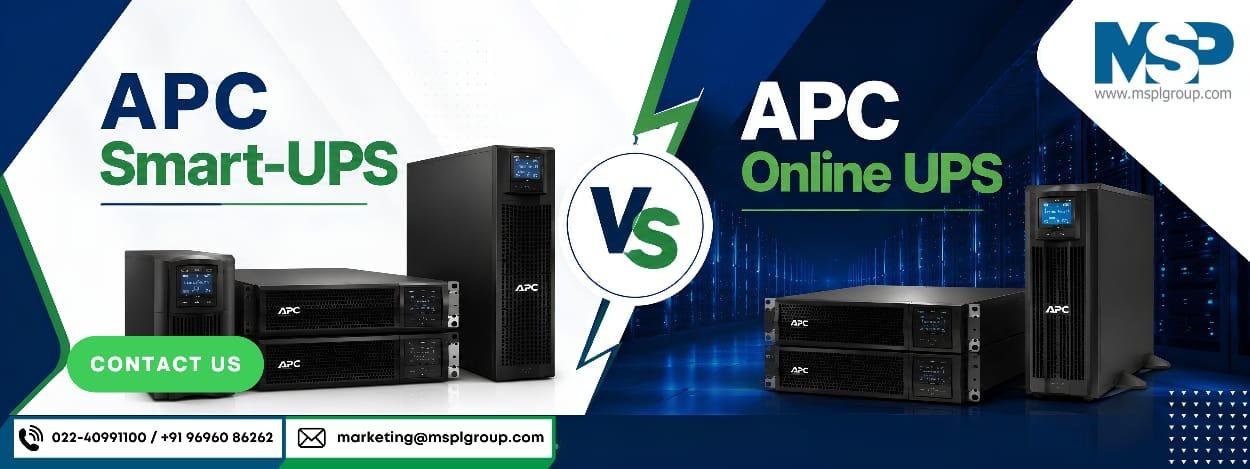
APC, a Schneider Electric brand, has a broad portfolio of UPS technologies. APC Smart-UPS products commonly use line-interactive topology in many models, while APC Online UPS systems use double-conversion technology. These are different approaches to power protection, and neither is automatically the best choice for every application.
This guide compares APC Smart-UPS vs APC Online UPS from a practical business and engineering perspective. It explains how the technologies work, where each fits, what affects UPS efficiency and battery runtime, how to evaluate ROI, and which questions a facility should answer before buying. Final sizing should always be based on the actual load profile, electrical environment, redundancy requirement and manufacturer specifications.
If you need dependable protection for office PCs, network switches, point-of-sale systems, small servers or general IT equipment with reasonably stable mains power, an APC Smart-UPS can be a strong choice. It can provide voltage regulation, battery backup, monitoring and protection without the complexity or energy consumption associated with a full double-conversion system.
If you operate a data center, server room, industrial automation system, medical equipment environment, telecom installation or other critical infrastructure where power quality and continuity are especially important, an APC Online UPS is often the stronger option. Double conversion continuously regenerates the output, providing a highly controlled power path and isolating the load from many incoming-power disturbances.The best answer is therefore: choose based on the criticality and electrical characteristics of the load, not simply on the UPS brand or advertised capacity.
APC Smart-UPS is a family of intelligent UPS systems designed primarily to protect IT and business equipment. Depending on the model, Smart-UPS units can provide features such as automatic voltage regulation, battery backup, network management, LCD status information, runtime estimation, event logging and remote monitoring.
Many Smart-UPS models use line-interactive UPS technology. Under normal conditions, the equipment is supplied through a conditioned mains path, while the UPS uses voltage regulation to correct certain overvoltage and undervoltage conditions without immediately switching to battery. During a power failure or unacceptable input condition, the UPS transfers the load to its inverter and battery system.This makes Smart-UPS particularly useful where the incoming electrical supply is generally acceptable but occasional outages, sags, surges or voltage variations need to be managed.
An APC Online UPS generally refers to a double-conversion UPS architecture. In this design, incoming AC power is converted to DC and then converted back to a controlled AC output. The critical load is therefore supplied by the inverter rather than being directly connected to the raw utility waveform during normal operation.
The major benefit is power conditioning and consistency. Variations in input voltage and frequency, electrical noise and other disturbances can be managed through the conversion process. When utility power fails, the battery supports the DC bus so the inverter can continue supplying the load, normally without the transfer event associated with a line-interactive topology.
Online double-conversion UPS systems are commonly considered for high-availability applications where the load is sensitive to power quality or where downtime has significant operational consequences.
| Feature | APC Smart-UPS / Line-Interactive* | APC Online / Double-Conversion* |
| Typical topology | Line-interactive | Double conversion |
| Voltage regulation | Yes, model dependent | Continuous output regulation |
| Battery operation during outage | Yes | Yes |
| Power conditioning | Good for many business environments | Stronger control of output power |
| Transfer to battery | Typically required during major input failure | Normally no transfer interruption because inverter is continuously active |
| Efficiency | Often high in normal operation | Depends on model and operating mode; generally designed for critical-load protection |
| Typical applications | Offices, network closets, small/medium IT | Data centers, critical servers, industrial and sensitive loads |
| Complexity | Moderate | Higher |
| Typical capital cost | Lower for comparable capacity | Higher for comparable capacity |
*Exact topology and features vary by model. Always verify the specific APC product datasheet before purchase.
A line-interactive Smart-UPS monitors the incoming supply and uses its internal electronics to regulate voltage. When the input remains within an acceptable range, the UPS can operate without continuously drawing battery power. When a blackout or severe power disturbance occurs, the inverter supplies the protected equipment from stored battery energy.
This architecture can be attractive for organizations seeking a balance between protection, efficiency and investment. For example, a branch office with a few servers, switches, routers and storage devices may not require the same power architecture as a high-density data center rack.
However, a buyer should look beyond the phrase “Smart-UPS.” The Smart-UPS family includes different form factors, capacities and feature sets. Battery chemistry, runtime, expansion capability, network management and output configuration can vary substantially between models.
An online double-conversion UPS creates a regenerated AC output. The rectifier converts utility AC to DC, and the inverter converts the DC into AC for the load. The battery is connected to the DC system so that it can support the inverter when utility power is unavailable.
Because the inverter continuously supplies the load, the architecture can provide a tightly controlled output and excellent protection against many common electrical disturbances. This is especially valuable for equipment whose operation can be disrupted by poor power quality, frequency variations or severe voltage events.
Online UPS systems can also support sophisticated operating modes and redundancy arrangements, depending on the product family and configuration. For large installations, engineering should consider bypass arrangements, maintenance bypass, battery autonomy, thermal management, harmonics, generator compatibility and future capacity requirements.
Data centers place unusual demands on power infrastructure. Loads can include servers, storage, networking, cooling controls and increasingly high-density GPU or AI equipment. The consequences of a power interruption can include service disruption, data loss, hardware stress and lost productivity.
For a conventional server room with moderate power density and a stable electrical supply, a suitably sized Smart-UPS may be adequate. For a critical data center or high-density computing environment, an online UPS may offer a more appropriate power-protection architecture.
A data center assessment should include current kW load, rack density, power factor, growth rate, required autonomy, redundancy target, generator interaction, bypass strategy and battery replacement plan. Capacity alone is not enough.
CTA: Planning a new server room or upgrading an existing data center? Get a professional UPS load assessment and solution recommendation before selecting the equipment.
For a small business server, firewall, switch stack or NAS, Smart-UPS can be an effective solution when the electrical environment does not justify a higher level of conditioning. Automatic voltage regulation can help address common utility fluctuations while preserving battery capacity for actual outages.
For mission-critical servers, clustered infrastructure or equipment operating in an electrically noisy environment, an online UPS may be preferable. It can provide a more controlled power supply and remove concerns about the transfer event associated with conventional standby or line-interactive architectures.
The right approach is to map each load to its criticality. Not every device in a facility needs the same UPS topology. A hybrid strategy can sometimes reduce capital expenditure while maintaining strong protection for the most important loads.
Industrial sites can experience voltage fluctuations, switching transients, generator-related disturbances and electrically noisy conditions caused by motors, drives and other equipment. Programmable logic controllers, industrial PCs, automation systems and control networks may be particularly sensitive to unstable power.
An online UPS can be a compelling choice for critical automation and control loads because its double-conversion architecture provides stronger isolation from many input disturbances. Smart-UPS may still be appropriate for less critical industrial IT and communications equipment where the electrical environment is relatively controlled.
Industrial UPS design should also evaluate ambient temperature, dust, ventilation, battery location, maintenance access and the behavior of connected loads during transfer or bypass operation.
Healthcare facilities cannot evaluate UPS systems on purchase price alone. Equipment such as diagnostic systems, laboratory infrastructure, medical IT, networking and critical communications may require carefully engineered power protection.
For non-life-critical IT loads, a Smart-UPS can be suitable when its specifications match the equipment and facility requirements. For highly sensitive or critical systems, online UPS technology may offer advantages through continuous conditioning and controlled output.
Any healthcare deployment must follow applicable electrical, safety and facility standards and should be engineered with the equipment manufacturer's requirements. UPS selection should be coordinated with qualified electrical and biomedical professionals where necessary.
Efficiency is important because a UPS operates for thousands of hours over its service life. A small efficiency difference can translate into meaningful electricity consumption and heat generation, particularly in large installations.
Battery runtime is influenced by load percentage, battery capacity, battery age, temperature, discharge characteristics and the UPS model. Runtime is not simply “minutes per kVA.” Two UPS systems with the same nominal capacity can have different battery configurations and runtime profiles.
Battery life also depends heavily on operating conditions. High temperature can accelerate battery degradation, while poor maintenance can reduce reliability. For critical installations, periodic battery health checks, appropriate environmental control and a planned replacement strategy can reduce unexpected failures.
An APC Smart-UPS generally has a lower entry cost for applications that do not require online double-conversion architecture. Online UPS systems typically involve a higher initial investment because of their power-conversion architecture and additional infrastructure requirements.
But purchase price is only one component of total cost of ownership.
| Cost factor | Smart-UPS | Online UPS |
| Initial equipment cost | Often lower | Often higher |
| Energy consumption | Can be advantageous in suitable environments | Depends on model and operating mode |
| Cooling impact | Generally lower at comparable efficiency | May be higher depending on efficiency and load |
| Battery replacement | Required | Required |
| Maintenance | Model and site dependent | Model and site dependent |
| Downtime risk | Depends on load and environment | Often better suited to highly critical loads |
| Scalability | Model dependent | Strong options available for critical infrastructure |
The economically correct choice is the system that minimizes total risk-adjusted cost, not necessarily the one with the lowest invoice value.
The ROI of an online UPS is closely connected to the financial impact of downtime. Suppose a business depends on a critical application that supports production, transactions or customer service. Even a short interruption can create labor costs, transaction losses, SLA penalties, recovery work and reputational damage.If an online UPS costs more but materially reduces the probability or impact of a power-related incident, the additional investment may be financially justified.
A simple evaluation can compare:
Expected annual downtime cost avoided − additional annual UPS ownership cost = potential financial benefit.
For example, a manufacturing plant losing production during an uncontrolled shutdown may value power continuity very differently from a small office where a brief outage affects only desktop computers. The correct ROI model should include downtime cost, equipment risk, energy cost, battery replacement and maintenance—not just purchase price.
CTA: Want to calculate the business case? Ask for a UPS TCO and ROI assessment based on your actual load, runtime and downtime exposure.
AI infrastructure introduces high-density, rapidly changing electrical loads. GPU servers can consume substantial power, and facilities must consider rack density, power distribution, cooling, redundancy and future expansion.
For high-density AI racks, online UPS architecture is often a strong candidate because the application can demand highly reliable, conditioned power. However, UPS selection must be based on the actual rack load, power factor, transient behavior, redundancy architecture and facility distribution design.
An AI-ready power strategy should also account for scalable UPS modules, upstream switchgear, PDUs, generator coordination, battery autonomy and thermal capacity. The UPS cannot be considered independently from the rest of the electrical infrastructure.
There is no universal answer because efficiency depends on the exact model, load level, operating mode and installation. Modern UPS platforms may offer high-efficiency operating modes, but these should be evaluated alongside power-quality requirements.
For a non-critical office or network environment, selecting a high-efficiency Smart-UPS can avoid paying for capabilities that are not needed. For critical infrastructure, energy efficiency should be balanced against power-quality performance, redundancy and availability.
A useful evaluation compares efficiency at the site's actual operating load, not only the headline maximum efficiency listed in marketing material.
UPS sizing starts with the connected load. Measure actual watts or kW where possible, identify startup characteristics, calculate required autonomy and allow sensible headroom for growth. VA alone can be misleading because power factor varies by equipment.
A practical assessment should document:
Avoid deliberately oversizing a UPS simply “for safety.” Excess capacity can increase capital cost and may place the UPS at an inefficient operating point. Proper engineering aims for an appropriate balance between capacity, resilience and future growth.
| Business requirement | Recommended direction |
| Office desktops and peripherals | Smart-UPS may be sufficient |
| Network switches and small IT closets | Smart-UPS is often suitable |
| Small/medium server room | Smart-UPS or Online, based on power quality and criticality |
| Mission-critical server infrastructure | Online UPS often preferred |
| Data center | Online UPS commonly considered |
| High-density AI/GPU racks | Online UPS is often a strong candidate |
| Industrial automation | Online for critical loads; Smart-UPS for suitable auxiliary IT |
| Sensitive laboratory/medical IT | Online often preferred where specifications require it |
| Unstable electrical supply | Online UPS may provide stronger protection |
| Cost-sensitive, non-critical IT | Smart-UPS may offer better value |
This matrix is a starting point, not a substitute for site-specific electrical engineering.
A high-quality UPS can still underperform if it is incorrectly installed, poorly maintained or operated with unsuitable batteries. Professional installation should verify cabling, earthing, breaker coordination, ventilation, battery configuration, load distribution and bypass arrangements.
Preventive maintenance can include visual inspection, electrical measurements, battery checks, alarm review, thermal inspection, cleaning and functional testing as appropriate to the equipment and site. Remote monitoring can further improve visibility into UPS alarms, battery status and operating conditions.
For businesses, an annual maintenance contract (AMC) can help establish a planned service schedule and escalation process. Battery replacement should be planned according to battery condition, manufacturer guidance and site requirements rather than waiting for a failure.
CTA: Need UPS installation, AMC, battery replacement or preventive maintenance? Speak with a qualified power-protection team to build a lifecycle support plan.
Is APC Smart-UPS an online UPS?
Not necessarily. “Smart-UPS” is a product family name, not a guarantee of one UPS topology. Many APC Smart-UPS models use line-interactive technology, while APC also offers online double-conversion UPS products. Always check the exact model specifications.
Is APC Online UPS better than Smart-UPS?
Not universally. Online UPS technology generally provides a higher level of continuous power conditioning, making it attractive for critical and sensitive loads. Smart-UPS can be a more economical and efficient choice for many office and IT applications where line-interactive protection is sufficient.
Which is better for a data center?
For critical data center infrastructure, online double-conversion UPS systems are commonly considered because of their power-quality and availability characteristics. The final selection depends on redundancy, load, runtime, efficiency, bypass and facility design.
Which UPS is better for servers?
Both can protect servers when correctly selected and installed. Small or less critical server environments may use Smart-UPS, while mission-critical servers often justify online UPS architecture.
Does an online UPS use more electricity?
It can have different efficiency characteristics from a line-interactive UPS because power conversion operates continuously, but modern online UPS systems can be highly efficient. Compare published efficiency at the expected site load and operating mode.
How long will an APC UPS battery last?
Battery life varies with chemistry, temperature, discharge cycles, charging conditions, maintenance and operating environment. Follow the manufacturer's recommendations and monitor battery health rather than relying on a fixed calendar assumption.
Can one UPS support high-density AI racks?
Potentially, but high-density AI infrastructure requires detailed load and electrical analysis. UPS capacity, rack power, redundancy, distribution, cooling, generator interaction and future expansion must all be evaluated together.
Should I choose UPS capacity based only on kVA?
No. Consider actual kW, power factor, load profile, startup behavior, runtime and growth. The UPS must be compatible with the electrical characteristics of the connected equipment.
The choice between APC Smart-UPS and APC Online UPS comes down to application criticality, power quality, electrical environment, uptime objectives and total cost of ownership.
Choose a suitably specified Smart-UPS when you need reliable protection for everyday IT and business equipment and do not require the continuous power-conditioning architecture of a double-conversion system. Consider an APC Online UPS when the application demands stronger power-quality control, high availability or protection for mission-critical infrastructure.
For data centers, industrial automation, healthcare IT, telecom systems and high-density AI infrastructure, the decision should be made through a site-specific assessment rather than a generic product comparison.
If you are unsure which UPS topology, capacity, battery runtime or redundancy configuration is right for your facility, request a professional UPS assessment. A properly engineered solution can protect critical equipment, reduce downtime risk and deliver a better long-term return on investment.

Your email address will not be published.


Comments