

Office No.104, Sahakar Niwas, Plot No.160/161, Rd no.2, Jawahar Nagar, Goregaon(West), Mumbai-400062
Office No.104, Sahakar Niwas, Plot No.160/161, Rd no.2, Jawahar Nagar, Goregaon(West), Mumbai-400062
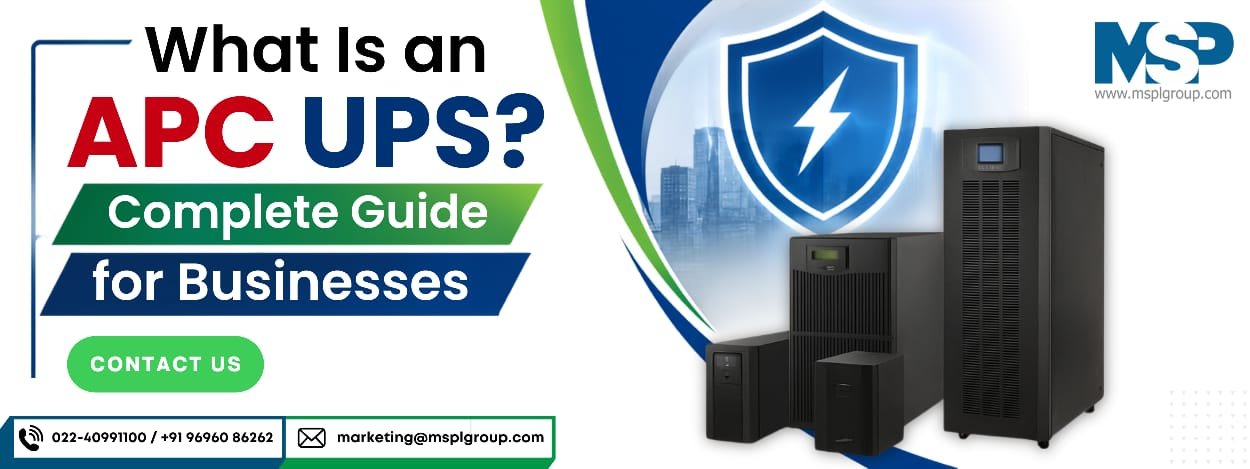
An APC UPS (Uninterruptible Power Supply) is a power protection system designed to provide backup power and protect critical equipment from electrical disturbances such as outages, voltage fluctuations, surges, and related power-quality problems.
APC is a flagship brand of Schneider Electric, offering UPS solutions for home and office equipment, servers and networks, and data-center and facility applications.For businesses, an APC UPS is more than a battery backup. The right system can help maintain business continuity, protect IT infrastructure, reduce unexpected downtime, and provide controlled shutdown or additional runtime when utility power fails.
APC Smart-UPS solutions, for example, are designed for applications including servers, point-of-sale systems, routers, switches, hubs, and other network equipment. Schneider Electric also offers APC Easy UPS and larger three-phase UPS solutions for business-critical environments.For organizations where downtime can directly affect revenue, productivity, customer service, or data availability, selecting the right UPS capacity and technology is an important infrastructure decision.
An APC UPS sits between the incoming electrical supply and connected equipment.Under normal conditions, the UPS supplies power to connected loads while managing power quality and charging its batteries. When the utility supply fails or moves outside acceptable limits, the UPS switches to battery power to keep supported equipment operating.The exact operating method depends on the UPS topology.
For example:
* Standby/offline UPS: Provides basic backup and protection.
* Line-interactive UPS: Adds voltage regulation and improved power conditioning.
* Online double-conversion UPS: Continuously converts incoming AC power to DC and then back to AC, providing a highly controlled output.
APC Smart-UPS includes line-interactive models as well as online double-conversion solutions.This makes UPS selection important because a small office PC and a mission-critical server may require very different levels of power protection.
Modern businesses depend heavily on electrical and digital infrastructure.
A short power interruption can:
An APC UPS helps provide continuity during power interruptions while also offering protection against certain power disturbances.For businesses operating servers, networking equipment, POS systems, medical equipment, or other critical electronics, Schneider Electric identifies APC Smart-UPS as a solution for protecting equipment and critical data from costly interruptions.
Business takeaway: The cost of a UPS should be evaluated against the potential cost of downtime, equipment damage, lost productivity, and interrupted services.
APC offers multiple UPS families and configurations for different applications.
1. APC Back-UPS
Back-UPS solutions are generally aimed at computers, home-office equipment, networking devices, and similar applications.
2. APC Easy UPS
Easy UPS solutions are designed to provide power protection for unstable power conditions. Schneider Electric offers single-phase and three-phase Easy UPS options for different business requirements.
3. APC Smart-UPS
Smart-UPS is designed for business IT environments and includes solutions for servers, network equipment, and other critical loads.
4. APC Smart-UPS On-Line
Online UPS systems use double-conversion technology and are suitable when higher levels of power conditioning and protection are required.
5. APC Symmetra
APC Symmetra provides modular, redundant, and scalable double-conversion online power protection for applications requiring higher availability.
A UPS and an inverter can both provide backup power, but they are not automatically equivalent.
| Feature | APC UPS | Conventional Inverter |
| Primary purpose | Power protection + backup | Backup power |
| IT equipment protection | Designed for critical electronics | Depends on model |
| Voltage regulation | Available on many models | Model dependent |
| Online double conversion | Available | Usually not |
| Network management | Available on selected models | Less common |
| Server applications | Suitable models available | Generally requires careful selection |
| Scalable runtime | Available on selected models | Configuration dependent |
| Business-critical applications | Strong option | Application dependent |
For servers, networking equipment, medical systems, and other sensitive loads, selecting a UPS based on topology, power quality, runtime, and management requirements is generally more appropriate than choosing a backup system based only on battery capacity.
APC Smart-UPS is a business-oriented UPS family designed for IT and network infrastructure.Schneider Electric describes Smart-UPS as intelligent network power protection suitable for servers, point-of-sale systems, routers, switches, hubs, and other network devices. Its portfolio includes both line-interactive and online solutions.Depending on the model, features can include:
Some Smart-UPS configurations also support lithium-ion battery technology and cloud-based remote monitoring.For an organization with distributed IT infrastructure, these management capabilities can make UPS maintenance and operational visibility easier.
An APC Online UPS uses double-conversion technology.The incoming AC supply is converted to DC and then converted back to controlled AC output. This architecture separates the connected load from many disturbances on the incoming electrical supply.
APC Smart-UPS On-Line and APC Easy UPS On-Line products use double-conversion online technology. Schneider Electric describes Easy UPS On-Line as providing protection against issues including brownouts, line noise, voltage transients, and outages.
Where is an online APC UPS useful?
It can be considered for:
Servers require stable and reliable power because an unexpected shutdown can affect applications, databases, network services, and business operations.APC Smart-UPS and online UPS solutions are designed for server and network applications.
For a server room, UPS selection should consider:
1.Total connected load
2.Required runtime
3.UPS capacity
4.Redundancy requirements
5.Battery technology
6.Input and output configuration
7.Generator compatibility
8.Network monitoring
9.Future expansion
10.Maintenance requirements
For larger data centers, three-phase and modular UPS architectures can provide additional capacity and availability options.
A small or medium-sized office may need UPS protection for:
For example, a 25-person office could use UPS systems to protect its networking equipment, selected workstations, and critical communication infrastructure.The key is to identify which loads are business-critical rather than putting every electrical device on battery backup.This approach can reduce unnecessary UPS capacity and improve the economics of the installation.
Manufacturing environments often have different power requirements from conventional offices.
A production facility may need UPS protection for:
For industrial environments, UPS selection should account for electrical conditions, load characteristics, environmental conditions, required autonomy, bypass arrangements, and maintenance access.Schneider Electric offers three-phase Easy UPS solutions for commercial, industrial, and business-critical applications.
Healthcare facilities cannot always tolerate unexpected power interruptions.
UPS applications may include:
The appropriate UPS should be selected according to the equipment manufacturer's electrical requirements and the facility's electrical design standards.APC Smart-UPS product information specifically identifies medical equipment among supported application categories for certain Smart-UPS models.
Choosing an APC UPS should not be based solely on the VA or kVA rating.
Consider these factors:
1. Calculate the connected load
Identify the actual wattage of the equipment that requires protection.
2. Determine required runtime
Decide whether you need a few minutes for an orderly shutdown or extended battery runtime.
3. Select the UPS topology
Line-interactive may be appropriate for some environments, while online double-conversion may be better for highly sensitive or mission-critical applications.
4. Consider redundancy
Critical facilities may benefit from redundant UPS configurations.
5. Check battery technology
APC systems can use different battery technologies depending on the model, including VRLA and lithium-ion options.
6. Plan for future growth
Avoid designing a system that becomes undersized immediately after business expansion.
7. Evaluate monitoring requirements
Network management and remote monitoring can improve visibility into UPS status and battery health.
UPS capacity is commonly specified in VA, kVA, watts, or kW, depending on the system.
A basic sizing process is:
Step 1: List all critical equipment.
Step 2: Determine the actual power consumption.
Step 3: Add an appropriate design margin.
Step 4: Select a UPS with suitable capacity.
Step 5: Determine the required battery runtime.
For example, if a critical IT load is approximately 8 kW, a business should not simply purchase an 8 kW UPS without evaluating headroom, power factor, starting characteristics, redundancy, expansion, and manufacturer specifications.For accurate sizing, a professional UPS assessment is recommended.Need help calculating your APC UPS requirement? Contact MSPL Group for a professional UPS load and backup assessment.
UPS runtime depends on several variables, including:
APC systems use battery technologies including VRLA/AGM and, in selected product families, lithium-ion.A higher-capacity battery system generally provides longer runtime, but simply adding batteries is not always the best solution. The UPS must be designed to support the required battery configuration.
Battery maintenance matters
Battery degradation can reduce actual backup performance.Regular maintenance can help businesses identify:
Modern businesses increasingly need visibility into their power infrastructure.Selected APC UPS systems can support network management and remote monitoring. Schneider Electric notes that APC UPS network management cards can provide remote monitoring and control through network-based interfaces, with configurable notifications for UPS events.
Remote monitoring can help IT and facility teams track:
For businesses with multiple locations or distributed server rooms, remote monitoring can reduce the need for manual checks.
UPS efficiency affects the long-term operating cost of a power protection system.A more efficient UPS can reduce the amount of energy lost during power conversion.For larger installations, even a small efficiency difference can become financially meaningful because the UPS may operate continuously.
For example:
Annual energy cost impact = UPS losses × operating hours × electricity tariff
Businesses should therefore evaluate both the initial purchase price and the total cost of ownership (TCO).
For larger three-phase applications, Schneider Electric highlights efficiency as one of the design considerations in its Easy UPS portfolio; for example, Easy UPS 3L lists efficiency of up to 96% for specified configurations.
An APC UPS should be evaluated as a business continuity investment rather than simply an electrical equipment purchase.
Consider a business where:
The potential productivity impact alone could be:
30 × ₹500 × 2 = ₹30,000
This does not include:
Therefore, preventing even a small number of serious interruptions can significantly improve the ROI of an appropriately sized UPS system.
APC UPS ROI can come from:
APC is one option within the broader UPS market.
Businesses may also evaluate brands such as Eaton, Vertiv, CyberPower, Socomec, Delta, and others.
| Evaluation Factor | APC | Other UPS Brands |
| IT UPS portfolio | Strong | Varies |
| Server/network applications | Yes | Varies |
| Online UPS | Yes | Yes |
| Three-phase solutions | Yes | Yes |
| Remote management | Available on selected models | Model dependent |
| Lithium-ion options | Available on selected models | Model dependent |
| Battery replacement ecosystem | Established | Brand/model dependent |
| Best choice | Depends on application | Depends on application |
The correct approach is to compare technology, capacity, runtime, efficiency, service support, warranty, battery availability, and total ownership cost rather than selecting a brand based only on name recognition.
Professional installation is important for business-critical UPS systems.
Installation considerations may include:
After installation, preventive maintenance should be planned.
A UPS maintenance program may include:
MSPL Group can help businesses with APC UPS installation, AMC, preventive maintenance, battery replacement, and power backup support.
A UPS may display warnings before a serious problem occurs.
Common issues include:
Battery replacement warning
Indicates that the battery may require replacement.
Overload
The connected load exceeds the UPS's designed capacity.
High temperature
Excessive ambient temperature can affect UPS and battery performance.
Low runtime
May indicate battery aging, increased load, or other system conditions.
Frequent battery operation
Repeated power disturbances can increase battery usage and affect battery life.
Communication failure
Network management problems can prevent remote monitoring or notifications.
Businesses should investigate recurring UPS alarms rather than simply resetting them.
Choosing and maintaining a business UPS requires more than selecting a product from a catalogue.
MSPL Group can support businesses with:
Our objective is to help businesses choose a power protection architecture aligned with their load, uptime requirements, budget, infrastructure, and future expansion plans.Looking for an APC UPS for your office, server room, data center, or industrial facility? Talk to MSPL Group for a customized recommendation and quotation.
What is an APC UPS?
An APC UPS is an uninterruptible power supply from APC, a Schneider Electric brand. It provides backup power and power protection for connected electrical and IT equipment.
Is APC UPS good for business use?
Yes. APC offers UPS solutions ranging from office and network protection to Smart-UPS and larger three-phase systems for business-critical applications.
What is the difference between APC Smart-UPS and APC Easy UPS?
They are different APC product families designed for different applications and requirements. Smart-UPS is strongly focused on business IT and network protection, while Easy UPS includes solutions for unstable power conditions and a broad range of business applications.
Is APC Smart-UPS an online UPS?
Some APC Smart-UPS models are line-interactive, while Smart-UPS On-Line models use double-conversion online technology.
How long does an APC UPS battery last?
Battery life depends on battery technology, operating temperature, usage, charging conditions, load, and maintenance. Businesses should monitor battery health and replace batteries when required.
Can an APC UPS protect servers?
Yes. Selected APC Smart-UPS and online UPS models are designed for servers and network infrastructure.
Can APC UPS systems be remotely monitored?
Selected APC UPS systems support network management and remote monitoring capabilities.
How do I select the right APC UPS size?
Start with the actual critical load in watts/kW, required runtime, UPS topology, redundancy requirements, future expansion, and electrical configuration. Professional UPS sizing is recommended for business-critical installations.
Is an APC UPS better than an inverter?
Not necessarily in every application. An APC UPS is specifically designed for power protection and backup, while an inverter's suitability depends on its design and application. For sensitive IT equipment, UPS topology and power-quality specifications should be evaluated carefully.
Where can I get APC UPS installation and maintenance?
Businesses can work with an experienced UPS service provider such as MSPL Group for UPS assessment, installation, AMC, maintenance, battery replacement, and power backup planning.
For businesses that depend on computers, servers, networking, POS systems, industrial controls, or other critical electronics, power interruptions can become expensive operational problems.An APC UPS can provide a combination of backup power, power protection, monitoring, and business continuity, depending on the selected model and configuration.
The best APC UPS is not necessarily the largest or most expensive one. It is the system correctly matched to your critical load, runtime requirement, power environment, scalability needs, and budget.From a small office network to a large data center, professional UPS sizing and maintenance can help businesses build a more reliable power infrastructure.
Need help selecting an APC UPS?
Get in touch with MSPL Group for a customized UPS assessment, sizing recommendation, installation, AMC, battery replacement, and ongoing power protection support.

Your email address will not be published.


Comments