

Office No.104, Sahakar Niwas, Plot No.160/161, Rd no.2, Jawahar Nagar, Goregaon(West), Mumbai-400062
Office No.104, Sahakar Niwas, Plot No.160/161, Rd no.2, Jawahar Nagar, Goregaon(West), Mumbai-400062
Industrial operations depend on a stable and continuous power supply. From manufacturing machinery and automated production lines to control panels, servers and monitoring systems, almost every modern industrial process relies on electricity. Even a short power interruption can affect production schedules, damage sensitive electronic equipment, interrupt data communication and increase operating costs. This makes a reliable power backup system an essential investment for industrial facilities.
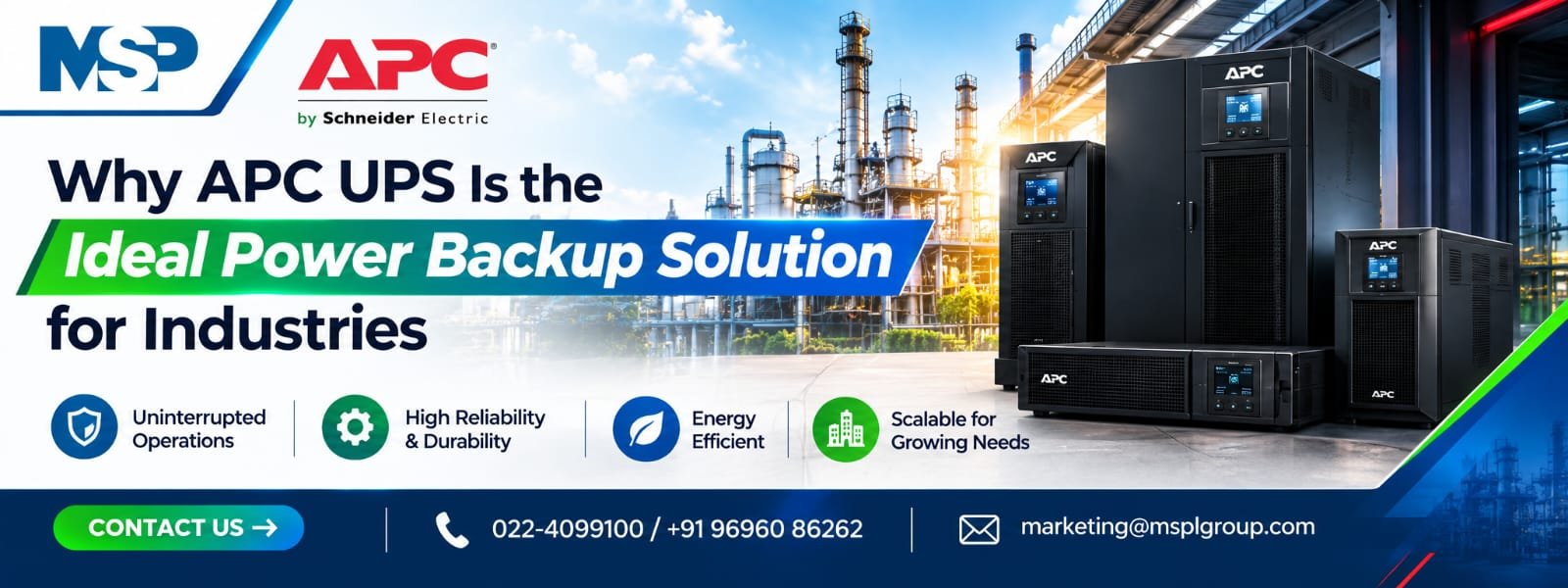
An APC UPS (Uninterruptible Power Supply) is a dependable option for protecting critical electrical and electronic equipment against unexpected power interruptions and fluctuations. APC, a leading power protection brand from Schneider Electric, offers a wide range of UPS solutions designed for different business and infrastructure requirements. Its product portfolio includes Back-UPS, Easy UPS, Smart-UPS and online UPS systems, allowing businesses to select suitable protection according to their applications.
For industries looking to improve operational reliability, selecting the right UPS is about more than simply providing battery backup. It involves understanding electrical loads, backup duration, equipment sensitivity, power quality and future expansion requirements. MSPL Group helps businesses explore suitable APC UPS solutions, professional installation, maintenance and power protection support to maintain business continuity.
An industrial UPS system provides temporary backup power when the main electricity supply fails or moves outside acceptable operating limits. It helps keep selected critical equipment running until the main supply returns or an alternative power source becomes available.Industrial environments often operate with heavy electrical loads, motors, automation systems and sensitive electronic equipment.
Power interruptions can create operational challenges such as:
A properly selected APC UPS can protect critical loads and help businesses maintain smoother operations during electrical disturbances.
APC by Schneider Electric has developed a broad range of power protection solutions for IT infrastructure, business environments and critical applications.One important advantage is the availability of different UPS technologies and capacity options. Businesses can choose solutions according to their connected equipment, power requirements and expected backup duration.
Depending on the model, APC UPS systems can offer:
These features make APC a practical option for industries that need reliable power protection for selected critical systems.
Industrial facilities may experience voltage fluctuations, electrical noise, brownouts, sudden interruptions and other power-quality problems.Such disturbances can affect sensitive electronic equipment, particularly computers, controllers, networking devices and monitoring systems.
APC UPS models offer different levels of electrical protection depending on their technology. Certain line-interactive models include Automatic Voltage Regulation (AVR), while online double-conversion models continuously process incoming power to provide controlled output.For critical industrial applications, selecting the appropriate topology is essential. An online APC UPS can be particularly useful where sensitive electronic equipment requires consistent power quality.
An APC online UPS uses double-conversion technology. Incoming AC power is converted into DC and then converted back into controlled AC power through the inverter.This arrangement helps isolate connected equipment from many disturbances in the incoming electrical supply.APC Easy UPS On-Line and Smart-UPS On-Line product families offer solutions for applications requiring higher levels of power protection.
Online UPS systems can be considered for:
Businesses should evaluate the load characteristics, required capacity and environmental conditions before selecting a model.
Manufacturing facilities depend on uninterrupted power for production monitoring, automation, quality control and essential electronic systems.Consider a manufacturing plant operating automated packaging equipment. A sudden interruption may stop the control system, interrupt production monitoring and require additional time for restarting the process.
An appropriately sized APC UPS can support selected critical loads such as:
It is important to understand that a UPS designed for control equipment may not be suitable for powering large motors or an entire production line. Those applications require a separate electrical and load assessment.
Automation plays an important role in modern manufacturing. PLCs, sensors, controllers, industrial PCs and SCADA systems help businesses monitor and control production processes.Unexpected power failures can interrupt communication between these systems and affect process continuity.An APC UPS can provide backup to selected automation and control equipment, helping prevent sudden shutdowns and supporting controlled recovery.
Before installation, businesses should consider:
Choosing the correct UPS configuration helps protect important automation infrastructure.
Modern industries use digital infrastructure to manage inventory, production records, communication, monitoring and business applications.Server downtime can interrupt access to important information and affect multiple departments.APC Smart-UPS and Smart-UPS On-Line solutions are designed for applications such as servers, networking equipment and other critical IT infrastructure.
Depending on the selected model, available features may include:
These capabilities help IT teams monitor power conditions and plan appropriate responses to electrical interruptions.
Every industrial facility has different power requirements. A small production unit may need protection for control equipment, while a large manufacturing plant may require a three-phase UPS installation.
The following table provides a general application guide.
| Industrial application | Suitable UPS consideration |
| Small control panels | Compatible APC Easy UPS or Smart-UPS |
| Industrial servers | APC Smart-UPS |
| PLC and automation systems | Suitable online UPS |
| Server rooms | APC Smart-UPS On-Line |
| Networking infrastructure | Smart-UPS |
| Critical three-phase loads | Appropriate three-phase UPS solution |
| Large industrial processes | Engineered industrial UPS system |
The final product selection should always be based on the actual electrical requirements and manufacturer's specifications.
Choosing between single-phase and three-phase power backup is an important part of industrial UPS planning.Single-phase UPS systems are commonly considered for smaller equipment loads, IT infrastructure, control systems and selected office applications.
Three-phase UPS systems are more appropriate for larger electrical installations and facilities with higher power requirements.
| Parameter | Single-phase UPS | Three-phase UPS |
| Typical application | Smaller critical loads | Larger critical installations |
| Power distribution | Single-phase supply | Three-phase supply |
| Common use | Servers and control systems | Industrial and facility infrastructure |
| Capacity planning | Based on connected load | Based on larger load distribution |
| Installation | Generally simpler | Requires detailed electrical planning |
The choice depends on the facility's electrical infrastructure, load distribution and backup objectives.
Equipment protection is one of the most important reasons industries invest in UPS systems.Unexpected shutdowns can interrupt automated processes, affect electronic controllers and create operational delays.An appropriately selected APC UPS helps maintain power to connected critical equipment during outages, giving operators time to restore normal supply or perform an orderly shutdown.
This can help industries:
A UPS cannot prevent every electrical or mechanical failure, but it can significantly improve protection against power-related interruptions.
Monitoring is an important part of managing critical power infrastructure.Certain APC Smart-UPS models support network management options that allow authorised teams to monitor UPS conditions remotely.
Depending on the model and configuration, monitoring capabilities may include:
Such information helps maintenance teams identify potential issues and plan service activities before they affect critical operations.
Selecting the right UPS capacity is essential for reliable performance.A UPS that is too small may become overloaded, while an unnecessarily large system may increase the initial investment.
Businesses should evaluate the following factors:
1. Total connected load: Calculate the combined power requirement of all equipment that needs backup.
2. Power factor: Understand the relationship between kW and kVA when selecting the UPS rating.
3. Backup duration: Determine how long critical equipment must continue operating during an outage.
4. Equipment sensitivity: Identify whether the connected equipment requires online double-conversion protection.
5. Future expansion: Consider additional machinery, servers or control equipment that may be installed later.
6. Electrical configuration: Check input and output voltage, phase requirements and distribution arrangements.
Professional load assessment helps identify a suitable UPS capacity and avoid unnecessary expenditure.
The battery is one of the most important components of any UPS system.Even a high-quality UPS cannot provide the expected backup duration if its batteries are ageing, damaged or improperly maintained.
Industrial businesses should follow a planned battery maintenance schedule that includes:
Battery life varies depending on temperature, operating conditions, usage patterns and battery technology.Regular maintenance helps businesses identify battery-related issues before an unexpected power failure occurs.
Businesses often compare UPS systems with generators and conventional power backup arrangements.
These solutions serve different purposes and can complement each other.
| Feature | APC UPS | Generator |
| Immediate backup | Battery-supported output | Requires starting and transfer |
| Power conditioning | Depends on UPS topology | Depends on generator and connected equipment |
| Backup duration | Limited by battery capacity | Depends on fuel availability |
| Typical application | Sensitive critical equipment | Longer-duration facility backup |
| Maintenance | UPS and battery servicing | Engine and fuel-system servicing |
For many industrial facilities, the most practical arrangement is a UPS for immediate power continuity combined with a generator for longer outages.This combination helps bridge the time between utility failure and generator operation.
Investing in a UPS system should be evaluated as a business continuity decision rather than only an equipment purchase.A power interruption can result in production losses, employee downtime, material wastage, data recovery expenses and equipment restart costs.
Consider a hypothetical manufacturing facility:
If the complete UPS investment is ₹5,00,000, the simple payback period would be:
₹5,00,000 ÷ ₹2,50,000 = 2 years.
This is an illustrative calculation, not a guaranteed saving. Actual ROI depends on installation costs, maintenance, battery replacement, energy consumption and the real reduction in power-related downtime.
Other potential financial benefits include:
Businesses can request a professional UPS assessment to understand their potential investment and savings.
Selecting the correct UPS model is only one part of a reliable power backup arrangement. Proper installation and commissioning are equally important.Incorrect electrical connections, inadequate ventilation, unsuitable battery arrangements or poor load distribution can affect UPS performance.
Professional installation should consider:
MSPL Group supports businesses with UPS-related consultation, installation and maintenance services to help establish suitable power protection arrangements.
Choosing the right power backup partner can make a significant difference to the performance and reliability of your electrical infrastructure.MSPL Group, Mahavir Sys-Power Pvt. Ltd., has been providing UPS and power backup solutions since 1994. The company works with businesses looking for suitable UPS products and services for commercial, industrial and critical power applications.
MSPL Group can assist businesses with:
Whether you need UPS protection for automation equipment, industrial control panels or critical IT infrastructure, MSPL Group can help assess your requirements and identify suitable solutions.
Looking for a reliable APC UPS solution for your industry? Contact MSPL Group at +91 08048128715 or visit https://www.msplgroup.com to discuss your power backup requirements.
1. Why is APC UPS suitable for industrial applications?
APC offers different UPS technologies, including online double-conversion and Smart-UPS solutions, which can protect selected industrial control systems, servers, networking equipment and other critical electronic loads.
2. Which APC UPS is best for manufacturing industries?
The appropriate model depends on the connected equipment, power requirements and backup duration. APC Smart-UPS and Easy UPS On-Line families may be suitable for selected critical loads, while demanding industrial environments may require a dedicated industrial UPS solution.
3. Can an APC UPS protect PLC and automation systems?
Yes. A suitably sized and compatible APC UPS can provide backup power to PLCs, HMIs, industrial computers and selected automation equipment.
4. What is the difference between an APC online UPS and a line-interactive UPS?
An online UPS uses double-conversion technology to continuously condition power, while a line-interactive UPS generally uses voltage regulation and switches to battery operation when input power moves outside acceptable limits.
5. How do I calculate the right UPS capacity for my factory?
Calculate the total load in watts, consider the power factor, identify the required backup duration and evaluate future expansion. A professional electrical assessment can help determine the correct kVA and kW ratings.
6. How long does an APC UPS provide backup?
Backup duration depends on the UPS model, battery capacity, connected load, battery condition and operating environment. Additional compatible battery packs may be available for certain models.
7. Does an APC UPS require regular maintenance?
Yes. Periodic inspection, battery health checks, alarm monitoring and appropriate servicing help maintain UPS performance and reliability.
8. Can an APC UPS work with a generator?
Yes, compatible UPS systems can operate with generators when the generator and UPS are correctly sized and their voltage, frequency and other electrical characteristics are compatible.
9. Why should industries choose an online UPS?
Online UPS systems provide continuous double-conversion power conditioning and are suitable for critical equipment that requires a higher level of power quality and continuity.
10. Where can I get APC UPS consultation and installation support?
Businesses can contact MSPL Group for UPS consultation, product selection, installation, maintenance and power backup planning.
Reliable power is essential for modern industrial operations. From manufacturing and automation to server rooms and communication infrastructure, businesses need dependable protection against unexpected electrical disturbances.APC UPS solutions offer a range of power protection technologies that can support different industrial and business requirements. Features such as online double-conversion technology, battery backup, voltage regulation and intelligent monitoring can help protect critical equipment and reduce power-related operational risks.
However, the best UPS solution is not necessarily the one with the highest capacity or the most features. It is the system that matches your actual electrical load, operating environment and business continuity requirements.With professional consultation, installation and maintenance support from MSPL Group, industries can make informed UPS investment decisions and build a more reliable power backup strategy.
Protect your industrial operations with the right APC UPS solution. Contact MSPL Group today at +91 08048128715 or visit https://www.msplgroup.com for expert assistance.

Your email address will not be published.


Comments